The best furnace filter for airflow is the correct physical size with the highest MERV rating your HVAC system can handle without excessive pressure drop. Here is how to choose safely and avoid common airflow problems.
What do you need help with?
Open an answer, or tell us what we should cover next.
Answered in this guide
Choose a furnace filter that balances clean air and airflow
Match the filter’s exact size first, then choose the highest MERV rating the HVAC system can handle. Consider filter thickness and construction because more surface area can improve filtration while helping maintain airflow.
Match the filter size and thickness to the HVAC system
Check the old filter’s nominal and actual length, width, and thickness before buying. Deeper media filters usually provide more surface area than 1-inch filters, but the replacement must fit the equipment and housing.
Diagnose whether a furnace filter is restricting airflow
Look for reduced airflow, unusual return noise, rapid filter loading, or changes after installing a new filter. Confirm the filter direction and other basic conditions before blaming the filter itself.
Know when to use a lower-MERV or deeper media filter
A lower-MERV filter may be the better choice when a higher rating reduces system airflow. A deeper media filter can offer more surface area, while persistent restrictions or system limits may require HVAC service.
Request a topic and help us choose what to build next.
Set a furnace filter replacement schedule
Fix low airflow caused by ducts, vents, or the blower
Requests help us prioritize the next guide. No email required.
One anonymous request per topic.
The best furnace filter that will not choke airflow is not necessarily the one with the highest MERV rating. Choose the exact filter size required by your system, then use the highest-efficiency rating your furnace or air handler is designed to support. A properly fitted MERV 8, 11, or 13 filter may be appropriate depending on the equipment, filter thickness, duct design, and advice from the manufacturer or an HVAC professional.
A filter that is too restrictive can reduce airflow, make the blower work harder, increase noise, reduce heating and cooling performance, and contribute to coil or heat-exchanger problems. A filter that is too loose, too small, or poorly sealed can allow dust to bypass the filter entirely.
Quick answer: which filter should you buy?
Use this decision order:
Match the exact length, width, and thickness. Check the size printed on the existing filter and confirm the dimensions printed on the replacement. The filter must fit securely without bending or leaving large gaps.
Check the equipment guidance. Look in the furnace, air-handler, or owner’s manual for a maximum recommended MERV rating or filter pressure-drop requirement.
Choose a moderate MERV rating unless your system supports higher efficiency. MERV 8 is often a basic residential choice; MERV 11 or MERV 13 may provide better fine-particle capture, but higher filtration can require more airflow capacity.
Prefer a deeper filter when the system is designed for one. A 4-inch or 5-inch media filter can often provide more surface area than a 1-inch filter, potentially reducing resistance at a similar filtration level. It is not interchangeable with a 1-inch slot.
Replace it on condition, not only on a calendar. Dusty homes, shedding pets, remodeling, wildfire smoke, and frequent HVAC use can load a filter faster.
If your system has recently developed weak airflow, do not automatically install a higher-MERV filter. First inspect the current filter, return grille, supply vents, and ductwork for blockage or leakage.
What MERV rating means for airflow
MERV, or Minimum Efficiency Reporting Value, describes how effectively a filter captures particles in standardized size ranges. A higher MERV rating generally indicates better capture of smaller particles, but it does not by itself tell you whether a particular filter will work well in your furnace.
Airflow depends on more than the MERV number, including:
The filter’s measured pressure drop at the system’s airflow
Two filters with the same MERV rating can have different airflow resistance. If airflow is a priority, look for the manufacturer’s pressure-drop data at an airflow close to your system’s needs. Lower pressure drop is generally preferable, but do not compare numbers taken at different airflow rates as if they were equivalent.
Is MERV 13 too restrictive?
MERV 13 is not automatically too restrictive, but it should not be installed blindly in every furnace. Some systems are designed to use it, while others may have inadequate return-air capacity or blower performance.
Check the HVAC manufacturer’s instructions or ask a qualified HVAC professional to confirm compatibility. This is especially important if you have a 1-inch filter, an older system, unusually noisy returns, weak airflow, or symptoms such as short cycling or a frozen cooling coil.
If your system cannot maintain adequate airflow with MERV 13, a lower-MERV filter that fits correctly may be a better choice than forcing a high-efficiency filter into an undersized filter slot.
Standard replacement filters for everyday residential use
Product prices and availability are accurate as of the date/time indicated and are subject to change. Any price and availability information displayed on Amazon.com at the time of purchase will apply to the purchase of this product.
Filter thickness matters as much as MERV
A 1-inch filter has a relatively small amount of filter surface area. A deeper filter, such as a 4-inch media filter, usually has more pleated material in the same face area and may offer more capacity for dust while maintaining manageable resistance. However, the cabinet, rails, and door must be designed for that thickness.
Do not place a 4-inch filter into a 1-inch slot or stack multiple 1-inch filters unless the equipment manufacturer specifically allows it. Doing so can restrict airflow, prevent the filter door from closing, or cause air to bypass the filter.
For a system that repeatedly struggles with airflow or loads a 1-inch filter quickly, an HVAC contractor may be able to evaluate whether a properly installed deeper media cabinet or larger return-air arrangement is practical.
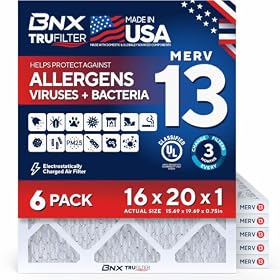
Higher-efficiency filters when the HVAC system supports them
Product prices and availability are accurate as of the date/time indicated and are subject to change. Any price and availability information displayed on Amazon.com at the time of purchase will apply to the purchase of this product.
How to choose the right furnace filter
1. Verify the nominal and actual size
Read the dimensions printed on the old filter, then compare them with the replacement packaging. Filter sizes are commonly described by nominal dimensions, while the actual measured dimensions can be slightly smaller to allow installation.
The replacement should:
Slide into the slot without excessive force
Stay in place without rattling
Fill the opening so air cannot easily go around it
Match the required thickness
Point in the correct airflow direction
If the old filter is bent, unusually loose, or difficult to remove, measure the slot and consult the equipment documentation instead of assuming the printed size is correct.
2. Select a reasonable efficiency level
For many ordinary homes, a moderate MERV rating is a sensible starting point. Move to a higher rating when there is a clear reason—such as reducing fine dust or supporting a household member with particular indoor-air-quality needs—and only after confirming that the HVAC system can handle it.
A higher MERV filter is not a substitute for source control, ventilation, humidity control, or a properly sized portable air cleaner. If fine-particle removal is the main goal, a dedicated air cleaner may improve filtration without forcing all return air through a highly restrictive furnace filter.
3. Consider pleat depth and construction
Pleated filters generally expose more media area than flat-panel filters. More surface area can help balance filtration and airflow, but pleats alone do not guarantee low resistance. Review the manufacturer’s airflow or pressure-drop information when it is available.
Avoid filters that collapse, bow, or visibly deform during operation. Deformation can create bypass gaps and may indicate an installation or airflow problem.
4. Buy a replacement pack only after confirming compatibility
Multi-packs can reduce the chance of delaying a filter change, but confirm that every filter has the exact size, thickness, and rating your system requires. Keep one unopened filter nearby so you can compare the replacement with the old filter before installing it.
Product prices and availability are accurate as of the date/time indicated and are subject to change. Any price and availability information displayed on Amazon.com at the time of purchase will apply to the purchase of this product.
Signs a filter may be choking airflow
A filter may be too restrictive, incorrectly installed, or simply overdue for replacement if you notice:
Weak airflow from several supply vents
A return grille that becomes unusually loud
Whistling or hissing around the filter slot
Longer heating or cooling cycles
The furnace turning off before reaching the thermostat setting
A high-temperature limit shutdown or repeated short cycling
Ice forming on an air conditioner’s indoor coil or refrigerant lines
A filter that bows inward while the blower runs
These symptoms can also come from blocked ducts, dirty coils, closed dampers, blower problems, refrigerant issues, or electrical faults. Do not keep operating equipment that repeatedly overheats, smells burnt, trips a breaker, or makes severe mechanical noise.
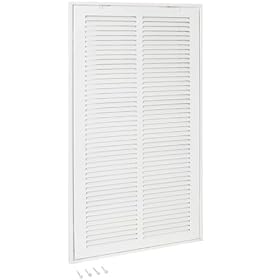
Replacement filter grille for a secure, properly sized fit
Product prices and availability are accurate as of the date/time indicated and are subject to change. Any price and availability information displayed on Amazon.com at the time of purchase will apply to the purchase of this product.
What to check before blaming the filter
If airflow dropped after changing filters, use this sequence:
Confirm the filter direction. The arrow should point toward the furnace or air handler, in the direction of airflow.
Check the size and thickness. A filter that is too thick or too large can block the return path.
Inspect for loading. Replace a visibly dirty, wet, collapsed, or damaged filter.
Look for bypass gaps. Air should not be able to flow freely around the filter frame.
Open supply vents and clear return grilles. Furniture, rugs, dust, or pet hair can obstruct airflow.
Inspect accessible ductwork. Disconnected, crushed, or leaking ducts can reduce delivered airflow.
Check the blower and coils only as directed by the manufacturer. Internal service may require shutting off power and should be handled by a qualified professional.
If a new filter immediately causes severe noise or weak airflow, reinstalling the old filter temporarily may help distinguish a filter-resistance problem, but do not continue using a damaged or badly loaded filter. Have the system evaluated if the symptoms persist.
When a lower-MERV filter is the better choice
A lower rating may be the practical choice when the system manual limits filtration, the filter is only 1 inch deep, airflow is already weak, or a higher-rated filter causes noticeable system problems. The filter still needs to fit tightly and be changed often enough to prevent loading.
Do not deliberately choose a filter that is too loose or remove the filter to improve airflow. Unfiltered dust can soil the blower and indoor coil, reduce efficiency, and create more expensive problems.
When to consider a deeper media filter or HVAC service
Consider professional evaluation when:
You want MERV 13 filtration but the system cannot maintain airflow
The filter loads unusually fast
The return grille is undersized or consistently noisy
The furnace short-cycles after a filter change
The filter slot has large gaps or does not hold filters securely
You need better filtration for smoke, allergies, or fine particles
Airflow is weak even with a clean, correctly installed filter
A contractor can measure system airflow and filter pressure drop, inspect the return side, and determine whether a deeper filter cabinet, larger return path, different blower setting, or separate air-cleaning equipment is appropriate. Do not alter blower wiring or fan-speed settings unless the manufacturer’s instructions and a qualified professional support the change.
Bottom line
Choose the exact filter size and thickness specified for your furnace, then use the highest MERV rating the equipment can support without excessive pressure drop. For many homes, a properly fitted moderate-MERV pleated filter is a safer airflow choice than an incompatible high-MERV filter. If you want higher filtration, confirm compatibility first—and investigate duct, grille, coil, and blower problems before assuming the filter is the only cause of poor airflow.
FAQ
What is the best MERV rating for good airflow?
There is no universal best rating. A properly fitted MERV 8, 11, or 13 filter may be appropriate depending on the furnace, filter thickness, return-air design, and manufacturer guidance. Higher MERV does not always mean better system performance.
Can a furnace filter be too restrictive?
Yes. Excessive filter resistance can reduce airflow, increase blower workload, cause noise, worsen heating or cooling performance, and contribute to equipment problems. Check the system manual and the filter manufacturer's pressure-drop information when available.
Is a 4-inch filter better than a 1-inch filter?
A 4-inch filter can provide more media surface area and may offer better dust-holding capacity or lower resistance, but only when the HVAC system has a cabinet designed for that thickness. It cannot simply replace a 1-inch filter.
How often should a furnace filter be replaced?
Replace it when it is visibly loaded, damaged, wet, or restricting airflow. The interval varies with filter size, household dust, pets, remodeling, smoke, and HVAC use. Follow the equipment and filter manufacturer's guidance, and check the filter regularly.
Should I use MERV 13 in an older furnace?
Not without checking compatibility. Some older or undersized systems may not maintain adequate airflow through a high-efficiency filter, particularly a 1-inch model. Consult the furnace documentation or a qualified HVAC professional before making the change.