An electronic air cleaner can be a practical alternative to disposable furnace filters, especially if you want reusable collection cells or lower ongoing filter waste. However, it requires regular cleaning, electrical compatibility, and careful attention to airflow and ozone concerns. For many homes, a properly sized pleated furnace filter remains the simpler option.
Comparisons · Mon Sep 07
Electronic Air Cleaner as an Alternative Path
An electronic air cleaner can reduce reliance on disposable furnace filters, but it is not automatically a better choice. Compare filtration, airflow, maintenance, compatibility, and ozone concerns before switching.
What an electronic air cleaner does
An electronic air cleaner uses an electrical charge to attract and collect airborne particles. Depending on the design, it may include:
- A prefilter that catches larger debris
- Charging wires or plates that electrically charge particles
- Collection plates that attract the charged particles
- A separate disposable filter or carbon section for odors
Some systems are installed in the return-air duct near the furnace or air handler. Others are portable room air cleaners that sit inside a living space. These are different products and should not be substituted for one another without checking the installation requirements.
An electronic air cleaner may capture dust, pollen, and other particles, but performance depends on the specific design, condition of the collection cells, airflow, and installation. Do not assume that every electronic air cleaner provides the same level of filtration as a particular MERV-rated filter.
Reusable electronic air-cleaner replacement components
 203368 F50F F300 Air Prefilter Replacement for Honeywell, 16'' x 12.5''ChangTa
$23.59 as of
View on Amazon 203368 Air Filter Fit for Honeywell Electronic Air Cleaner 16" x 12.5"MUEYTE
$26.50 as of
View on Amazon WINGMAN1 20x25x1 Electronic Air Filter Replacement Pads - 4 ChangesWINGMAN1
$49.97 as of
View on Amazon
Product prices and availability are accurate as of the date/time indicated and are subject to change. Any price and availability information displayed on Amazon.com at the time of purchase will apply to the purchase of this product.
Electronic air cleaner vs. a disposable furnace filter
Disposable filters are simpler
A pleated furnace filter is usually the easiest option to install and maintain. You replace it when it becomes loaded with dust, using the size and performance rating specified for the system.
Its main advantages include:
- No electrical connection beyond the furnace itself
- Predictable replacement intervals
- Easy visual inspection
- Broad availability in standard sizes
- No collection cells or charging wires to clean
The main limitation is ongoing replacement cost and waste. A high-efficiency filter can also restrict airflow if it is too dense for the furnace, too dirty, or installed in a system that cannot handle the added resistance.
Electronic air cleaners reduce disposable filter use
A reusable electronic air cleaner typically uses washable collection components. That can reduce the number of disposable filters you purchase, but it does not eliminate maintenance. Cells, prefilters, and contact points need cleaning according to the manufacturer's instructions.
A dirty electronic air cleaner can collect less particulate matter and may increase airflow resistance. It can also cause arcing, warning lights, or unusual noises if the cells are wet, damaged, or incorrectly installed.
Neither option fixes every air-quality problem
Particle filtration does not remove every indoor pollutant. Dust and pollen are different from gases, odors, moisture, and biological contaminants. If odors or chemical vapors are the primary concern, look for a system designed for gas-phase filtration rather than assuming a particle collector will solve the problem.
Source control, ventilation, humidity control, and regular HVAC maintenance may be more important than changing filtration technology.
Lower-restriction pleated alternative
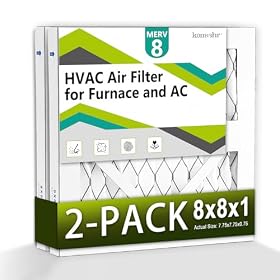 8x8x1 Air Filter MERV 8 (2-Pack), HVAC/Furnace AC Filter Replacement, Dust Defense–Comparable with MPR 600…Komashr
$9.99 as of
View on Amazon Enviroflow 20x22x1 Pollen and Dust Control Pleated Replacement AC/Furnace Air Filter, MERV 8, Pack-8Enviroflow
$50.69 as of
View on Amazon Komashr 10x10x1 Air Filter MERV 8 (4-Pack), HVAC/Furnace AC Filter Replacement, Dust Defense–Comparable with MPR…Komashr
$17.99 as of
View on Amazon
Product prices and availability are accurate as of the date/time indicated and are subject to change. Any price and availability information displayed on Amazon.com at the time of purchase will apply to the purchase of this product.
What to check before choosing an electronic air cleaner
1. Confirm the furnace and duct compatibility
Check the furnace or air-handler documentation and the electronic air cleaner's installation requirements. Pay attention to:
- Required cabinet or duct dimensions
- Return-air opening size
- Available electrical power
- Airflow direction
- Required clearance for removing cells
- Compatibility with the blower and control system
A filter cabinet may need modification for some installations. Electrical work and duct alterations should be handled by a qualified HVAC professional when required by local code or the manufacturer's instructions.
2. Check the airflow impact
The air cleaner must allow the furnace to move the required amount of air. A system that causes excessive resistance can contribute to poor heating or cooling performance, noisy operation, longer run times, or overheating concerns.
Do not compare a MERV rating and an electronic air cleaner as if they were interchangeable numbers. MERV is a standardized filter-performance rating for many mechanical filters. Electronic air cleaners use different designs and may be evaluated using different published performance information.
Ask for the manufacturer's airflow-resistance data and particle-capture information when available. If the system has a minimum airflow requirement, it must be checked during installation.
3. Understand the maintenance routine
Before choosing a reusable system, make sure the cleaning routine is realistic for your household. Maintenance may include:
- Turning off power to the air cleaner
- Removing the prefilter and collection cells
- Washing components as directed
- Allowing parts to dry completely
- Inspecting wires, plates, and contact points
- Reinstalling components in the correct direction
- Replacing disposable sections if the design uses them
Never wash or reinstall electronic components while they are wet. Follow the manufacturer's instructions for disconnecting power and handling the cells.
4. Ask about ozone emissions
Some electronic air-cleaning technologies can produce ozone as a byproduct, particularly designs that intentionally ionize air. Ozone is an indoor air contaminant and may irritate the lungs.
If ozone is a concern, look for independently verified low- or zero-ozone performance and check the applicable safety certification. Be cautious with vague claims such as “fresh air” or “active purification” that do not identify the technology or provide emissions information.
People with asthma, respiratory sensitivity, children, older adults, and pets may warrant extra caution. When in doubt, consult a qualified HVAC professional or indoor-air-quality specialist.
Higher-efficiency mechanical alternative
 BNX TruFilter 20x20x1 Air Filter MERV 13 AC Filter, HVAC Furnace Filter, 6 Pack (ACTUAL…BNX
$47.98 as of
View on Amazon Komashr 12x12x1 Air Filter MERV 13 (4-Pack), HVAC/Furnace AC Filter Replacement, Dust Defense–Comparable with MPR…Komashr
$21.49 as of
View on Amazon BNX TruFilter 14x18x1 MERV 13 (4-Pack) AC Furnace Air Filter - MADE IN USA -…BNX
$33.29 as of
View on Amazon
Product prices and availability are accurate as of the date/time indicated and are subject to change. Any price and availability information displayed on Amazon.com at the time of purchase will apply to the purchase of this product.
When a higher-efficiency furnace filter may be the better alternative
A pleated filter can be the better choice when you want low complexity and easy replacement. Start with the filter size printed on the existing filter or specified by the equipment documentation. Then consider the highest practical MERV rating that the furnace can handle without excessive airflow restriction.
A higher MERV rating is not automatically better for every system. The filter's actual resistance depends on its construction, surface area, dust loading, and airflow. A filter that is too restrictive can create problems even when its rating looks attractive.
If you want to move to a substantially higher MERV filter, ask an HVAC professional to check airflow and system operation. A deeper filter cabinet may provide more filtration area with less resistance than a thin filter, but the cabinet and furnace must be compatible.
When an electronic air cleaner may make sense
An electronic air cleaner may be worth considering when:
- You want to reduce disposable filter use
- You are willing to clean collection cells regularly
- The furnace has a suitable return-air installation location
- The manufacturer provides clear performance and maintenance information
- Ozone emissions are documented and acceptable
- An HVAC professional can verify airflow and electrical compatibility
It may be a poor fit when the system is difficult to access, household maintenance is inconsistent, replacement cells are hard to obtain, or the installation would require major duct changes.
Troubleshooting common electronic air-cleaner problems
The system is not collecting much dust
Check the prefilter and collection cells first. Heavy buildup, incorrect installation, wet components, or damaged plates can reduce performance. Confirm that the air cleaner is switched on and that any service indicator is not signaling a fault.
If the components are clean and correctly installed, check whether air is bypassing the cabinet through gaps around the frame. Persistent bypass leakage may require a replacement gasket, cabinet repair, or professional adjustment.
The air cleaner makes snapping or popping sounds
Occasional electrical snapping can occur in some designs, but frequent or loud arcing should not be ignored. Turn off power and follow the manufacturer's inspection procedure. Look for wet cells, bent plates, broken wires, debris, or incorrect reassembly.
Do not touch internal electrical parts until power has been disconnected as directed. If the noise continues after cleaning and drying, stop using the unit and contact a qualified technician.
The furnace is noisy or has weak airflow
Check for a clogged prefilter, blocked return grille, dirty collection cells, closed supply registers, or an incorrectly installed filter. Also check that the cells and access door are seated properly.
If airflow remains weak, the issue may involve duct restrictions, blower operation, coil contamination, or an incompatible air-cleaner cabinet. A professional airflow check is appropriate rather than removing filtration permanently.
The unit has a warning light or will not power on
Verify that the access door is fully closed and that the power switch or control is enabled. Check the manufacturer's reset procedure. Do not bypass a safety interlock.
If the unit still will not operate, the cause may be a failed power supply, control board, wiring connection, or other electrical component. Electrical diagnosis should be performed by a qualified technician.
Bottom line
An electronic air cleaner is an alternative to a disposable furnace filter, not an automatic upgrade. Choose it when reusable collection, documented performance, accessible maintenance, and verified compatibility justify the added complexity. Choose a properly sized pleated filter when simplicity, easy replacement, and predictable maintenance matter more.
Whichever system you use, keep the return path clear, replace or clean filtration on schedule, and confirm that the furnace is receiving adequate airflow. Follow the equipment manufacturer's instructions for installation, cleaning, and electrical safety.
FAQ
Is an electronic air cleaner better than a MERV filter?
Not universally. An electronic air cleaner may reduce disposable filter use, but it requires cleaning and electrical components. A properly sized pleated filter is often simpler and more predictable. Compare the specific system's airflow resistance and particle-capture information rather than comparing the technologies by rating alone.
Can an electronic air cleaner replace the furnace filter?
Some whole-house electronic air cleaners are designed to serve as the primary return-air filtration system, while others require a disposable prefilter or secondary filter. Follow the equipment manufacturer's instructions and do not remove a required filter without confirming the system's design.
Do electronic air cleaners produce ozone?
Some technologies can produce ozone, especially systems that intentionally ionize air. Check for documented low- or zero-ozone emissions and applicable safety certification before buying. Avoid relying on vague marketing claims.
How often does an electronic air cleaner need cleaning?
The interval depends on the design, household dust levels, pets, occupancy, and HVAC runtime. Follow the manufacturer's schedule and inspect the prefilter and collection cells sooner if airflow declines or visible buildup appears.
Can I install an electronic air cleaner myself?
Some units are designed for straightforward installation, but whole-house systems may require duct modifications, electrical connections, airflow verification, and code compliance. Use a qualified HVAC professional when the installation involves wiring, cabinet changes, or uncertainty about furnace compatibility.