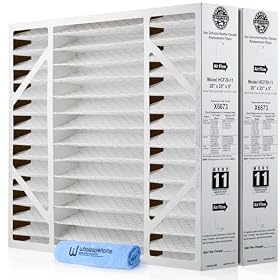
MERV 13 filters capture more smaller particles than MERV 11 filters, but they may also create more resistance to airflow. The better choice depends on the filter’s actual pressure drop, your HVAC system’s capacity, and the manufacturer’s recommendations—not MERV rating alone.
MERV 11 versus MERV 13 in the same thickness
If a MERV 11 and MERV 13 furnace filter have the same thickness, the MERV 13 generally provides finer filtration—but it can also restrict airflow more. That does not mean every MERV 13 will cause a problem or that every MERV 11 is better for airflow. Filter construction, pleat design, surface area, condition, and the HVAC system itself all affect the result.
For most homes, choose the highest rating your furnace or air handler is designed to handle while keeping the filter correctly fitted and changed on schedule. Check the equipment manual or ask a qualified HVAC professional if the manufacturer does not specify an acceptable filter rating or pressure drop.
What the MERV ratings mean
MERV, or Minimum Efficiency Reporting Value, describes how effectively a filter captures particles across a range of particle sizes. A higher rating generally indicates better capture of smaller particles under the test standard.
In practical terms:
MERV 11 offers meaningful filtration for common household dust, pollen, and other airborne particles.
MERV 13 captures a greater share of smaller particles and is often considered when improving filtration for fine airborne particles, smoke, or respiratory concerns.
Neither rating removes every pollutant, and neither replaces source control, ventilation, or a properly sized air-cleaning system.
MERV is an efficiency rating, not a direct airflow rating. Two same-thickness filters with the same MERV rating can have different resistance because their media, pleat depth, face area, and construction differ.
MERV 11 versus MERV 13 at the same thickness
Filtration performance
MERV 13 is the stronger filtration choice when the HVAC system can support it. It is designed to capture more of the smaller particles included in the MERV test ranges than MERV 11.
That advantage matters most when fine-particle filtration is a priority. However, the improvement is useful only if the filter remains installed correctly and the HVAC system continues to move enough air.
Airflow and pressure drop
A filter creates resistance as air passes through it. A MERV 13 may have a higher pressure drop than a MERV 11 of the same thickness, especially if the filter has less usable media area or becomes loaded with dust.
Reduced airflow can contribute to:
Longer heating or cooling run times
A noisy return grille or whistling filter slot
Reduced comfort in some rooms
A furnace overheating or cycling on a safety limit
A frozen air-conditioning coil in cooling mode
Higher blower energy use
These symptoms do not prove that MERV 13 is the cause. A dirty filter, undersized return duct, closed registers, leaky filter rack, or blower problem can produce similar signs.
Filter life
Neither rating has a universal replacement interval. A MERV 13 filter may load faster in a dusty home, during construction, with pets, or when outdoor smoke is present. A MERV 11 can also become restrictive when dirty.
Inspect the filter according to the manufacturer’s guidance and replace it when it is loaded, damaged, damp, or due for replacement. Do not extend the replacement interval simply because the filter appears thicker or more expensive.
Product prices and availability are accurate as of the date/time indicated and are subject to change. Any price and availability information displayed on Amazon.com at the time of purchase will apply to the purchase of this product.
Does the same thickness make MERV 11 and MERV 13 interchangeable?
Not automatically. Matching the nominal dimensions and thickness is necessary, but it does not confirm HVAC compatibility.
Before switching ratings, check:
The actual filter size. Verify length, width, and thickness on the existing filter and in the equipment documentation. Nominal sizes can differ slightly from actual dimensions.
The equipment manufacturer’s recommendation. Some systems specify a maximum filter rating or maximum allowable pressure drop.
The filter’s published pressure-drop data. Compare data at the airflow conditions relevant to your system when available. A MERV rating alone cannot predict resistance precisely.
The installation direction. Follow the airflow arrow printed on the filter.
The fit. The filter should not bow, collapse, or leave large gaps around the frame.
The system’s symptoms after installation. Watch for unusual noise, weak airflow, short cycling, overheating, or a cooling coil that begins to ice.
If your system uses a central return filter grille, also confirm that the grille and filter rack support the selected thickness. Do not force a thicker filter into a slot that is not designed for it.
Product prices and availability are accurate as of the date/time indicated and are subject to change. Any price and availability information displayed on Amazon.com at the time of purchase will apply to the purchase of this product.
Which one should you choose?
Choose MERV 11 when
MERV 11 is often the conservative choice when:
Your equipment documentation does not approve MERV 13
The system already has weak airflow or a restrictive return path
You have experienced blower noise or furnace limit trips
You need good general household filtration without moving to a higher rating
The available MERV 11 filter has better published airflow characteristics than the MERV 13 alternative
A properly fitted MERV 11 that is changed on time can be preferable to a higher-rated filter that excessively restricts the system.
Choose MERV 13 when
MERV 13 may make sense when:
The furnace or air handler manufacturer supports it
The system has adequate return airflow and blower capacity
Fine-particle filtration is a higher priority
The selected filter’s pressure-drop data is acceptable for the system
You can monitor the filter and replace it before it becomes heavily loaded
If you are considering MERV 13 because of allergies, smoke, or another specific concern, remember that filtration results also depend on how long the system runs, how well the building is sealed, and whether particles are being generated indoors.
Product prices and availability are accurate as of the date/time indicated and are subject to change. Any price and availability information displayed on Amazon.com at the time of purchase will apply to the purchase of this product.
How to switch from MERV 11 to MERV 13 safely
Turn the HVAC system off before removing the filter.
Confirm the replacement filter’s dimensions and airflow direction.
Install the MERV 13 without bending or crushing the frame.
Restart the system and listen for new whistling, rattling, or unusual blower noise.
Check that supply airflow remains reasonable throughout the home.
After the system has operated, look for short cycling, furnace shutdowns, or an air-conditioning coil that begins to frost.
If symptoms appear, reinstall the previous filter and consult the equipment documentation or an HVAC professional.
Do not bypass the filter, run the system without one, or modify the filter rack to force a different size.
When a filter change does not solve an airflow problem
If either filter rating causes noticeably poor airflow, inspect the basic causes before blaming MERV alone:
Confirm the filter is not backwards or visibly clogged.
Check for a collapsed filter or packaging material left on the media.
Make sure return grilles and supply registers are not blocked.
Look for gaps around the filter frame that allow unfiltered air to bypass the media.
Check whether the system has multiple filters and whether one was overlooked.
Verify that access panels are closed and seated correctly.
If the furnace overheats, repeatedly shuts down, makes unusual electrical or blower noises, or the air conditioner develops ice, turn the system off as appropriate and contact a qualified HVAC professional. Electrical, blower, duct, and refrigerant problems require more than a filter swap.
Bottom line
MERV 13 filters generally provide finer particle filtration than MERV 11 filters of the same thickness, but the best choice is not automatically the highest rating. Compare the filter’s pressure-drop information with the HVAC manufacturer’s requirements, choose the correct size, and replace it before it becomes loaded. If system airflow is already marginal, MERV 11 may be the safer choice unless a qualified professional confirms that MERV 13 is suitable.
FAQ
Is MERV 13 always better than MERV 11?
MERV 13 generally captures more smaller particles, but it may create more airflow resistance. It is only the better overall choice when the HVAC system can handle the filter and the filter is maintained properly.
Can I replace a same-size MERV 11 filter with MERV 13?
Not automatically. Check the furnace or air-handler manual, the filter’s pressure-drop information, and the system’s airflow condition. Same dimensions do not guarantee the same resistance or compatibility.
Will MERV 13 damage my furnace?
A compatible MERV 13 filter should not damage a properly designed system, but an overly restrictive filter can contribute to inadequate airflow, overheating, or cooling-coil icing. Follow the equipment manufacturer’s requirements and seek professional advice when unsure.
Does MERV 13 need to be changed more often than MERV 11?
Not necessarily, but any filter can become restrictive as it loads with dust. Homes with pets, construction dust, smoke, or high occupancy may require more frequent inspection and replacement.
What should I do if airflow drops after installing MERV 13?
Confirm the size and airflow direction, make sure the filter is not damaged or blocked, and check that return grilles are open. If airflow remains poor or the furnace cycles off, reinstall the previous filter if safe and contact an HVAC professional.