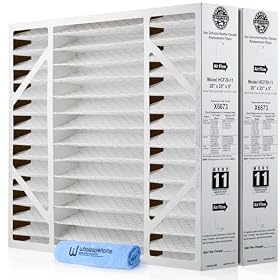
The best 5-inch furnace filter is the one that matches the rack’s exact size and your system’s approved airflow resistance—not simply the filter with the highest MERV rating.
A 5-inch furnace filter can provide more dust-holding capacity than a standard 1-inch filter, but the rack size alone does not identify the correct replacement. The best choice is a filter with the same actual dimensions as the existing filter, a MERV rating your HVAC system can handle, and an airflow direction that matches the arrow on the frame.
Start with the filter already in the rack
Before ordering, remove the current filter and record everything printed on its frame or cardboard edge:
Nominal size: A label such as 16 x 25 x 5 is a rounded trade size.
Actual dimensions: The replacement may be slightly different from the nominal size. Measure length, width, and thickness if the label is missing or unclear.
MERV rating: Note the current rating, if listed.
Airflow arrow: The arrow should point toward the furnace or air handler.
Filter type: Some cabinets use a specific media shape, gasket, rail, or end-cap design.
A replacement that is too large may not slide into the rack. One that is too small can allow unfiltered air to bypass the media, reducing filtration and potentially allowing dust into the blower and indoor coil.
What makes a good 5-inch filter?
Exact fit comes first
A filter should slide into the cabinet without being forced and should sit securely with minimal open gaps around the frame. Do not substitute a filter based only on a similar nominal size. Compare the actual dimensions and the filter’s orientation with the old one.
Filter thickness is also important. A filter made for a 5-inch cabinet may not be interchangeable with a 4-inch or 6-inch filter, even if the length and width are identical.
Use a sensible MERV rating
MERV indicates how effectively a filter captures particles under standardized conditions. Higher MERV ratings generally provide finer filtration, but they can also create more airflow resistance, depending on the filter’s construction and condition.
MERV 8: A common choice for basic household dust and larger airborne particles.
MERV 11: Provides finer filtration and may suit households seeking more control over smaller particles, if the HVAC system supports it.
MERV 13: Often selected for improved capture of fine particles, but the system must be able to maintain adequate airflow with that filter installed.
Do not choose MERV 13 solely because it is the highest rating available. A restrictive filter can contribute to weak airflow, longer heating or cooling cycles, coil icing in some systems, or furnace overheating. Check the furnace, air-handler, or filter-cabinet instructions first. If the manufacturer does not state an acceptable MERV rating or pressure-drop limit, an HVAC professional can check system airflow and static pressure.
Look for airflow information when available
MERV is not a complete measure of how restrictive a filter will be. Filter media, surface area, pleat depth, and the manufacturer’s pressure-drop data also matter. Two filters with the same MERV rating can have different airflow resistance.
A deep 5-inch filter has more media area than a shallow filter, which can help it hold more dust before becoming restrictive. However, replacement intervals still depend on household dust, pets, construction, indoor-air conditions, and system runtime.
Product prices and availability are accurate as of the date/time indicated and are subject to change. Any price and availability information displayed on Amazon.com at the time of purchase will apply to the purchase of this product.
Best choice by situation
If you want a straightforward replacement
Choose the same nominal and actual size, the same thickness, and the same MERV rating as the filter currently installed. This is usually the lowest-risk option when the system has been operating normally.
If you want finer particle filtration
Consider moving from MERV 8 to MERV 11 or MERV 13 only after confirming that the HVAC manufacturer or installer permits the rating. A properly sized deep-pleat filter with documented airflow performance is preferable to a higher-rated filter that fits poorly or restricts the system.
If the filter is hard to find
Search using the complete size, thickness, MERV rating, and any special cabinet or media type printed on the existing filter. For example, include the actual dimensions rather than searching only for “5-inch furnace filter.” If the old filter has a gasket, wire support, rigid frame, or unusual end cap, match that feature as well.
If the rack is empty or the fit is uncertain
Do not run the HVAC system for an extended period without the intended filter in place. Confirm the cabinet’s required dimensions and filter orientation from the equipment documentation or the rack label. If the rack appears damaged, bent, or modified, have it evaluated before buying a large replacement pack.
Product prices and availability are accurate as of the date/time indicated and are subject to change. Any price and availability information displayed on Amazon.com at the time of purchase will apply to the purchase of this product.
Installation and replacement tips
Turn off the furnace or air handler before removing the filter if the equipment instructions recommend doing so.
Check the arrow on the new filter. It normally points toward the blower and equipment, not toward the return-air room.
Slide the filter fully into the rails without crushing or bending it.
Confirm that the access door closes and that there are no obvious bypass gaps.
Write the installation date on the filter frame.
Inspect the filter periodically rather than relying only on a calendar schedule.
A 5-inch filter may last longer than a 1-inch filter, but “lasts longer” does not mean it can be left in place indefinitely. Replace it when the media is visibly loaded, airflow declines, or the manufacturer’s schedule calls for replacement. Homes with pets, remodeling dust, smokers, or frequent HVAC operation may require more frequent changes.
Product prices and availability are accurate as of the date/time indicated and are subject to change. Any price and availability information displayed on Amazon.com at the time of purchase will apply to the purchase of this product.
When a different solution is better
If the existing rack does not hold the filter securely, has large bypass gaps, or causes the filter to bow, replacing the filter alone may not solve the problem. A properly fitted filter grille, new media cabinet, or cabinet repair may be more appropriate.
If the system develops weak airflow, unusual noise, repeated high-limit shutdowns, coil icing, or overheating after a higher-MERV filter is installed, remove the filter only as a temporary diagnostic step and follow the equipment instructions. Install a compatible replacement and arrange professional service if the symptom returns. Never operate a furnace without the required filtration for longer than necessary.
The reasonable next step is a replacement filter when the rack is intact and the old filter’s specifications are clear. Consider a replacement cabinet or qualified HVAC evaluation when the filter size is uncertain, the fit is poor, or the system cannot maintain normal airflow with an approved filter.
FAQ
Can I use any 5-inch furnace filter if the rack is already installed?
No. Match the filter’s actual length, width, thickness, frame style, airflow direction, and any cabinet-specific features. A filter with the same nominal size can still have different actual dimensions.
Is MERV 13 too restrictive for a furnace?
Not necessarily, but compatibility depends on the equipment, filter design, and system airflow. Check the furnace or air-handler documentation before upgrading, because a higher MERV rating can increase resistance.
How often should a 5-inch furnace filter be replaced?
Follow the filter and equipment manufacturer’s guidance, then adjust based on inspection. Pets, construction dust, smoking, and heavy system use can load a filter faster.
What should I do if the replacement filter does not slide into the rack?
Do not force it. Recheck the actual dimensions, thickness, rails, and airflow orientation against the old filter. If the rack or filter frame is damaged, consult the equipment documentation or an HVAC professional.