A 4-inch cabinet upgrade costs more upfront than staying with a 1-inch furnace filter, but the right choice depends on more than the filter price. Include the cabinet, installation, replacement filters, service access, and potential airflow benefits in the comparison. If your current 1-inch filter loads quickly or causes high resistance, the upgrade may be worthwhile; if the existing system has adequate airflow and modest filter costs, staying with 1 inch may be the less expensive option.
Sizing · Mon Sep 07
Cost of a 4 inch cabinet upgrade versus staying on 1 inch
A 4-inch filter cabinet usually costs more upfront, but its larger media area can reduce replacement frequency and pressure drop. Here is how to compare the upgrade with continuing to buy 1-inch filters.
What the upgrade cost includes
A cabinet upgrade generally has three cost components:
- The larger filter cabinet or media box — This replaces or modifies the existing filter-holding arrangement.
- Installation labor — The cabinet may need to be fitted into the return-air ductwork, sealed, and supported.
- The replacement filters — A 4-inch filter is usually more expensive per filter than a 1-inch filter, although it may last longer.
The final amount varies substantially by furnace location, return-duct layout, cabinet dimensions, access, and local labor rates. A straightforward cabinet installation is different from a job that requires duct modifications, moving wiring, or rebuilding a return plenum. Get an itemized quote that separates equipment, labor, ductwork, sealing, and any service call charges.
Do not assume a 4-inch filter can simply be placed in the existing 1-inch slot. The deeper filter needs a compatible cabinet or housing with the correct airflow direction, dimensions, and access clearance.
Replacement filters for the upgraded cabinet
 Filtrete 16x25x4 Air Filter MERV 12, MPR 1550 Certified Asthma & Allergy Friendly 2-Pack, Fits…Filtrete
$53.90 as of
View on Amazon Filtrete 20x25x4 Air Filter MERV 12, MPR 1550 Certified Asthma & Allergy Friendly 2-Pack, Fits…Filtrete
$50.00 as of
View on Amazon Filtrete 20x20x4 AC Furnace Air Filter, MPR 1550, MERV 12, Fits Honeywell, CERTIFIED Asthma &…Filtrete
$59.99 as of
View on Amazon
Product prices and availability are accurate as of the date/time indicated and are subject to change. Any price and availability information displayed on Amazon.com at the time of purchase will apply to the purchase of this product.
Staying with a 1-inch filter
The lower-cost option is to keep the existing housing and continue buying the correct 1-inch replacement filter. This avoids installation work and usually has the lowest initial expense.
A 1-inch setup may make sense when:
- The filter is easy to replace on schedule.
- The filter does not become visibly loaded before its expected replacement interval.
- The furnace and blower maintain normal airflow.
- Heating and cooling performance are satisfactory.
- A contractor has not identified excessive return-air restriction.
- The existing filter size and MERV rating meet your indoor-air-quality needs.
The drawback is that a 1-inch filter has limited depth for filter media. To provide more filtration, manufacturers may use a denser media, but a higher MERV rating can increase resistance if the filter area and HVAC system are not suited to it. A cheap 1-inch filter that is replaced frequently can also cost more over time than expected.
Replacement filters for the existing setup
 Filtrete 20x30x1 Air Filter, MERV 11, MPR 1000, Allergens & Pet Dander, 3-Month AC and…Filtrete
$22.72 as of
View on Amazon Filtrete 14x24x1 Air Filter, MERV 11, MPR 1000, Allergens & Pet Dander, 3-Month AC and…Filtrete
$21.49 as of
View on Amazon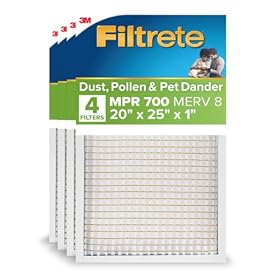 Filtrete 20x25x1 AC Furnace Air Filter, MERV 8, MPR 700, Tough on Pollen, Easy on…Filtrete
$45.99 as of
View on Amazon
Product prices and availability are accurate as of the date/time indicated and are subject to change. Any price and availability information displayed on Amazon.com at the time of purchase will apply to the purchase of this product.
Why a 4-inch filter may cost less over time
A 4-inch filter has more media depth and often more usable surface area than a 1-inch filter of the same face dimensions. That can allow it to collect dust over a longer interval while maintaining lower resistance than a similarly rated 1-inch filter.
Potential operating advantages include:
- Longer replacement intervals, depending on dust load and manufacturer guidance.
- Less frequent filter changes.
- More filtration media available before the filter becomes loaded.
- A better chance of achieving a higher MERV rating without creating as much restriction as a dense 1-inch filter.
These are not guaranteed savings. A 4-inch filter may still load quickly in a dusty home, during construction, with pets, or when the system runs continuously. The correct replacement interval should be based on the filter's condition and the HVAC manufacturer's recommendations—not simply on the filter's depth.
Higher-filtration option when system-compatible
 Honeywell 20" X 25" X 4" FC200E1037 Air Filter Replacement - MERV 13 (2 Pack)Honeywell
$88.88 as of
View on Amazon BNX TruFilter 20x20x4 (19.5’’ x 19.5’’ x 3.63‘’ Slim Fit) MERV 13 Air Filter (2-Pack)…BNX
$53.09 as of
View on Amazon
Product prices and availability are accurate as of the date/time indicated and are subject to change. Any price and availability information displayed on Amazon.com at the time of purchase will apply to the purchase of this product.
Compare annual filter cost, not just the price per filter
Use this basic calculation for each option:
Annual filter cost = price per filter × filters used per year
For a more complete comparison, add the installation cost of the 4-inch cabinet and spread it over the number of years you expect to keep the HVAC system:
Annualized upgrade cost = cabinet and installation cost ÷ expected years of use
Then compare:
- 1-inch annual cost: 1-inch filter expense per year
- 4-inch annual cost: 4-inch filter expense per year plus the annualized cabinet installation cost
For example, if a 1-inch filter must be replaced every month while a compatible 4-inch filter lasts several months, the higher price of each deep filter may be partly or fully offset by fewer purchases. Use actual filter prices and observed replacement intervals rather than assuming a fixed lifespan.
Also account for the fact that a 4-inch filter cabinet may remain useful when the furnace is replaced, but compatibility is not automatic. Confirm the cabinet dimensions and airflow capacity with the HVAC contractor before treating it as a long-term asset.
The hidden cost of poor airflow
The main financial reason to consider a deeper filter is often not filter replacement cost. It is avoiding airflow problems caused by an overly restrictive filter or undersized return system.
Excessive resistance can contribute to:
- Reduced heating or cooling performance
- Longer run times
- A noisy blower or whistling filter area
- Furnace limit trips or cooling-coil freeze-ups in some systems
- Greater blower strain
- Uneven temperatures throughout the home
A 4-inch cabinet does not automatically fix an undersized return duct, a dirty coil, or an improperly designed system. It provides more space for filter media, but the complete return-air path still needs to be suitable.
Ask the contractor whether the proposed cabinet and filter combination is appropriate for the system's required airflow. If available, a professional should evaluate pressure across the filter and other major restrictions rather than choosing a high-MERV filter by rating alone.
When the upgrade is usually easier to justify
A 4-inch cabinet upgrade is more likely to make financial and practical sense when:
- You replace 1-inch filters very frequently.
- The 1-inch filter becomes dirty well before the expected interval.
- You want better particle filtration but are concerned about restricting airflow.
- The current filter rack is flimsy, difficult to seal, or poorly supported.
- You plan to keep the HVAC system for several more years.
- The return duct has enough room for a properly sized media cabinet.
- A qualified HVAC professional recommends the setup after considering airflow.
It may be less attractive when the furnace is near replacement, the installation requires extensive duct reconstruction, or the current 1-inch system already provides acceptable airflow and reasonable filter costs.
How to request comparable quotes
Ask for two written options:
- Stay with the current 1-inch setup: Include the recommended filter size and MERV rating, any needed sealing or rack repair, and expected maintenance.
- Install a 4-inch cabinet: Include the cabinet dimensions, compatible filter size, installation labor, duct modifications, sealing, access requirements, and any airflow or pressure evaluation.
The quote should also state whether the new cabinet fits the available return-air space. A cabinet that is too small, poorly sealed, or installed where the filter cannot be changed conveniently may create more trouble than it solves.
Do not select a filter solely because its MERV number is higher. Follow the furnace and filter-cabinet manufacturer's guidance, and have a qualified professional evaluate changes to ductwork or airflow when needed.
Bottom line
Staying with 1-inch filters usually has the lowest upfront cost. A 4-inch cabinet can become the lower-cost choice over several years if it reduces replacement frequency and supports adequate airflow, but the result depends on the installation quote, actual filter life, and HVAC compatibility.
Use your real annual 1-inch filter spending, obtain an itemized cabinet-installation quote, and compare the annualized costs. If the upgrade is being considered because of weak airflow, noise, or a high-MERV filter problem, solve the airflow question first rather than treating the deeper cabinet as an automatic fix.
FAQ
Is a 4-inch furnace filter cheaper than a 1-inch filter?
Not usually per filter. A 4-inch filter generally costs more to purchase, but it may last longer and require fewer replacements. Compare annual filter spending rather than the price of one filter.
How long does a 4-inch furnace filter last?
The interval depends on filter media, MERV rating, system runtime, pets, dust, construction, and household conditions. Check the filter regularly and follow the filter and HVAC manufacturer's guidance instead of relying on a fixed number of months.
Can I put a 4-inch filter in a 1-inch slot?
No. A deeper filter normally requires a compatible cabinet or media housing with the correct dimensions and airflow path. Do not force it into a 1-inch rack.
Does a 4-inch filter improve furnace airflow?
It can create less resistance than a similarly restrictive 1-inch filter because it provides more media area, but it does not correct an undersized return duct, dirty coil, blocked grille, or other airflow problem. The complete system should be evaluated.
Is a 4-inch cabinet upgrade worth it before replacing the furnace?
It may not be. If the furnace is near replacement, ask whether the new cabinet will work with the planned system. A cabinet upgrade is easier to justify when the existing HVAC system has several years of useful service remaining and the installation is straightforward.