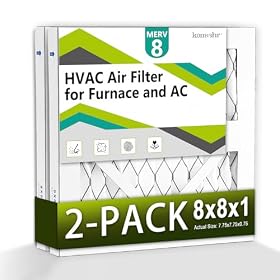
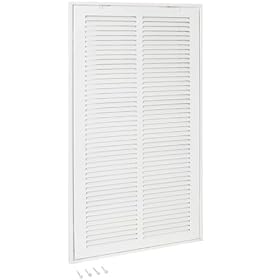
If you cannot modify your rental’s filter rack, the safest approach is to match the existing filter size and choose a moderate-efficiency filter that fits without restricting airflow.
Filter for a rental you cannot upgrade the rack
If you rent and cannot enlarge or replace the furnace filter rack, buy a filter that matches the existing opening exactly. Start with the filter’s nominal size, then choose a MERV rating that provides useful filtration without making the system work harder than the rack and blower can handle.
For most fixed residential systems, a correctly sized pleated filter in the rack’s existing thickness—often 1 inch—is the practical choice. Do not force a thicker filter into a shallow slot or assume that the highest MERV rating is automatically best.
Measure the existing filter before ordering
Look at the cardboard edge of the current filter for a printed size such as 16 x 25 x 1. If the size is readable, use that as your starting point. The listed dimensions are usually nominal, while the filter’s actual dimensions may be slightly smaller so it can slide into the rack.
Remove the filter and measure its length, width, and thickness.
Check the rack or filter grille for a stamped size.
Confirm the airflow arrow on the replacement filter will point toward the furnace or air handler.
A filter that is slightly too large may bend, crush, or leave gaps. A filter that is too small can allow unfiltered air around the edges. If your measurements do not match a common nominal size, do not force a standard filter into the opening; ask the landlord or HVAC service provider about the correct replacement size.
Match the filter thickness to the rack
A rental with a narrow filter slot generally requires a 1-inch filter. A 2-inch, 4-inch, or thicker filter may hold more dust and potentially last longer, but it needs a rack designed for that thickness. It should not be squeezed into a 1-inch opening.
Do not stack multiple thin filters to imitate a thicker filter. Stacking can reduce airflow, make the filters difficult to remove, and create an installation that the furnace was not designed to use.
If the existing rack is damaged, loose, or too shallow for the filter specified by the equipment manufacturer, the appropriate fix is a landlord-approved repair or HVAC service—not a thicker filter forced into place.
Product prices and availability are accurate as of the date/time indicated and are subject to change. Any price and availability information displayed on Amazon.com at the time of purchase will apply to the purchase of this product.
Choose a reasonable MERV rating
MERV, or Minimum Efficiency Reporting Value, describes how effectively a filter captures different particle sizes under a standardized test. A higher MERV rating generally provides finer filtration, but the filter can also create more resistance to airflow, especially when it is dirty or installed in a shallow 1-inch rack.
For a rental system that cannot be upgraded, a moderate MERV rating is usually the conservative choice. Many homeowners use filters in the MERV 8 to MERV 11 range for general dust and household particle control. A MERV 13 filter may be useful for certain fine-particle concerns, but it should be used only if the furnace or air handler manufacturer, landlord, or HVAC professional allows it and the system maintains adequate airflow.
The rating alone does not determine performance. Filter construction, pleat depth, actual size, how dirty the filter becomes, and how much filter surface area the system has all matter.
When a MERV 13 filter may be a poor fit
A high-efficiency filter can be a problem when:
The filter is only 1 inch thick.
The return grille or rack is small.
The blower already struggles to maintain airflow.
The filter becomes visibly dirty quickly.
Supply airflow is weak or uneven after installation.
The furnace manufacturer does not approve the rating.
If you want better particle filtration but cannot modify the rack, ask the landlord or an HVAC professional whether a compatible filter grille, larger return, or deeper rack can be installed. Do not make permanent changes to a rental without permission.
Moderate-efficiency filter for a shallow rental rack
Product prices and availability are accurate as of the date/time indicated and are subject to change. Any price and availability information displayed on Amazon.com at the time of purchase will apply to the purchase of this product.
Install it without creating an air leak
Before inserting the new filter, check the rack and surrounding grille for debris, bent metal, or a loose access panel. The filter should slide in without excessive force and sit flat.
Follow these steps:
Turn off the system if the filter is near moving equipment.
Remove the old filter.
Confirm the new filter’s length, width, and thickness.
Point the airflow arrow toward the furnace, air handler, or return-side blower.
Make sure the filter is fully seated and not bowed.
Close the grille or access panel securely.
Restore power and listen for unusual whistling or rattling.
A small amount of sound from airflow can be normal, but a sudden whistle may indicate a gap, a filter that is too restrictive, or a panel that is not seated correctly.
Product prices and availability are accurate as of the date/time indicated and are subject to change. Any price and availability information displayed on Amazon.com at the time of purchase will apply to the purchase of this product.
Watch for airflow warning signs
After installing a different filter, check the system during both heating and cooling. Warning signs include:
Weak airflow from multiple supply vents
A whistling return grille
Longer heating or cooling cycles
The furnace shutting off before reaching the thermostat setting
The blower running unusually loudly
A coil or furnace compartment that appears to frost, where visible
If the furnace repeatedly shuts down, smells hot, trips a breaker, or produces unusual electrical or combustion-related symptoms, turn it off and contact the landlord or a qualified HVAC professional. Do not remove safety controls or work inside the furnace cabinet.
Replacement filter grille for landlord-approved airflow improvement
Product prices and availability are accurate as of the date/time indicated and are subject to change. Any price and availability information displayed on Amazon.com at the time of purchase will apply to the purchase of this product.
Replace the filter on a schedule based on condition
A filter’s service life depends on the home, pets, construction dust, smoking, and system runtime. Check a 1-inch filter about once a month at first. Replace it when it is visibly loaded with dust or according to the furnace and filter manufacturer’s instructions.
A filter that is overdue for replacement can restrict airflow just as much as an overly efficient filter. If a new filter becomes heavily dirty unusually quickly, look for construction dust, a missing filter cover, gaps around the rack, or a return-air leak. In a rental, report persistent problems to the landlord rather than altering the ductwork yourself.
What to buy when the rack cannot be changed
For most rental applications, look for:
The exact nominal size printed on the old filter or rack
The same thickness as the existing filter
A pleated design rather than a loose or poorly supported panel
A MERV rating approved for the equipment, commonly a moderate rating for a shallow rack
A multi-pack only after confirming the size and fit
A replacement filter is the right next step when the current filter is dirty, damaged, or missing. If the rack cannot hold the manufacturer-specified filter, has large bypass gaps, or causes repeated airflow problems, the reasonable next step is a landlord-approved rack or return-air repair—not repeatedly buying higher-MERV filters.
FAQ
What filter should I use in a rental furnace if I cannot change the rack?
Use the same nominal length, width, and thickness as the existing filter or the size marked on the rack. For a shallow rack, a moderate MERV rating is usually a conservative choice unless the equipment manufacturer specifies otherwise.
Can I use a 2-inch filter in a 1-inch furnace filter slot?
No. A thicker filter should only be used in a rack designed for that thickness. Do not force it into the slot or stack two thin filters.
Is MERV 13 too restrictive for a rental furnace?
It may be, particularly in a 1-inch rack or a system with limited return-air capacity. Use MERV 13 only when the furnace or air handler manufacturer permits it and airflow remains adequate; ask the landlord or an HVAC professional if uncertain.
How do I know which way the furnace filter goes?
The arrow on the filter should point in the direction of airflow—normally toward the furnace or air handler, not toward the room.
What should I do if the filter size does not fit the rack?
Do not bend or force the filter. Recheck the nominal size, measure the old filter, and inspect the rack for a marked size. If the dimensions still do not match, contact the landlord or HVAC service provider.