A furnace filter size is usually written as width × length × thickness, such as 16 × 25 × 1 inches. The important catch is that the printed size is often a nominal size, while the filter’s actual dimensions may be slightly smaller. To choose the right replacement, read the label, confirm the filter’s thickness, and measure the existing filter or filter opening if anything is unclear.
Sizing · Mon Sep 07
How to Read Furnace Filter Size | Actual vs. Nominal Dimensions
Furnace filter sizes are usually printed as nominal dimensions, which may be slightly larger than the filter’s actual measurements. Here’s how to read the label, measure your system, and choose a replacement that fits without restricting airflow.
Read the three filter dimensions in order
Most furnace filters list dimensions in this order:
- Width — the shorter or horizontal dimension, depending on how the filter is installed
- Length — the other face dimension
- Thickness — the filter’s depth, such as 1, 2, 4, or 5 inches
A label marked 16 × 25 × 1 refers to a filter intended for a nominal 16-inch-by-25-inch opening and approximately 1 inch of thickness.
The first two dimensions can generally be rotated if the filter fits the same opening. Thickness cannot be substituted casually. A filter that is too thick may not slide into the rack, while a thinner filter may leave gaps that allow air to bypass the filter.
Replacement filters matching a known size
 Filtrete 16x25x5 Air Filter MERV 11, MPR 1000 Micro Allergen Defense 2-Pack, Fits Lennox, AC…Filtrete
$49.81 as of
View on Amazon Filtrete 20x20x1 Air Filter MERV 5, 6-Pack AC Furnace HVAC, MPR 300 Basic Dust Defense,…Filtrete
$27.96 as of
View on Amazon
Product prices and availability are accurate as of the date/time indicated and are subject to change. Any price and availability information displayed on Amazon.com at the time of purchase will apply to the purchase of this product.
Nominal size versus actual size
The size printed on a furnace filter is commonly rounded for compatibility with a filter rack or return-air grille. The actual filter may be somewhat smaller than the nominal dimensions shown on the package.
For example, a filter labeled with a whole-inch nominal size may have measured dimensions that are fractions of an inch smaller. The exact difference varies by manufacturer and filter design, so do not assume that every filter with the same label has identical actual dimensions.
When replacing a filter, match the labeled size and thickness of the filter that fits your system. If the old filter has no readable label, measure it and compare those measurements with the manufacturer’s published actual dimensions before ordering.
Pleated filters for routine replacement
- Filtrete 20x20x1 Air Filter MERV 5, 6-Pack AC Furnace HVAC, MPR 300 Basic Dust Defense,…Filtrete
$27.96 as of
View on Amazon  Simply 20x20x1 Air Filter, Merv 8, MPR 600, 6 Pack, Furnace Air Filter for HVAC…Simply
$35.07 as of
View on Amazon Filtrete 20x25x4 Air Filter MERV 12, MPR 1550 Certified Asthma & Allergy Friendly 2-Pack, Fits…Filtrete
$50.00 as of
View on Amazon
Product prices and availability are accurate as of the date/time indicated and are subject to change. Any price and availability information displayed on Amazon.com at the time of purchase will apply to the purchase of this product.
Find the size printed on the old filter
Start with the existing filter if it is available. Look along the cardboard frame or edge for a label showing:
- Nominal width, length, and thickness
- Actual dimensions, sometimes listed separately
- An airflow arrow
- A replacement or part number
- The filter’s MERV rating or other performance information
Write down the complete size, including thickness. A label such as 20 × 20 × 1 is not interchangeable with 20 × 20 × 2 unless the filter rack is designed for both sizes and the replacement seals correctly.
If the old filter is heavily loaded with dust, avoid relying on its appearance to judge fit. Dirt can obscure the label and may make the frame look swollen or damaged.
Higher-efficiency replacement option
 BNX TruFilter 20x20x1 Air Filter MERV 13 AC Filter, HVAC Furnace Filter, 6 Pack (ACTUAL…BNX
$47.98 as of
View on Amazon Aerostar Air Filter 20x20x1 MERV 13 AC Filter, HVAC, Furnace Filter, 4 PackAerostar
$34.19 as of
View on Amazon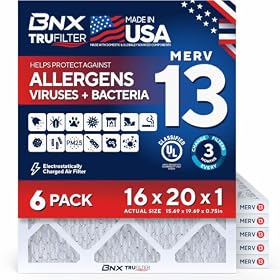 BNX TruFilter 16x20x1 Air Filter MERV 13 AC Filter, HVAC Furnace Filter, 6 Pack (ACTUAL…BNX
$47.19 as of
View on Amazon
Product prices and availability are accurate as of the date/time indicated and are subject to change. Any price and availability information displayed on Amazon.com at the time of purchase will apply to the purchase of this product.
Measure the filter or opening
If the label is missing, measure the old filter with a tape measure or ruler. Measure:
- The width across the filter face
- The length from the other edge
- The thickness through the filter frame
Measure the filter frame rather than the pleated media. Record the measurements before removing or discarding the old filter.
If there is no filter available, measure the filter slot or return-air grille. Measure the opening’s width, length, and depth, but do not assume the opening measurement is the same as the filter’s actual size. The filter needs to slide into the track and seal against the intended edges without being forced.
A loose filter can allow unfiltered air around its perimeter. A filter that must be bent, crushed, or forced into place is the wrong size or may indicate a damaged rack.
Check where the filter goes
Filters may be installed in several locations, including:
- A return-air grille in a wall or ceiling
- A slot beside the furnace or air handler
- A cabinet-mounted filter rack
- A media filter cabinet attached to the return duct
A home can have more than one return grille, and some systems use multiple filters. Check each location rather than assuming that one filter size applies everywhere.
If several filters are installed, they may be the same size, but confirm this before buying a replacement pack. Some systems use different sizes at different returns.
Do not confuse thickness with filtration performance
The thickness dimension describes how much space the filter occupies. It does not, by itself, tell you how well the filter removes particles.
Filtration performance is commonly described with a MERV rating. A higher MERV rating can capture smaller particles, but it may also create more resistance to airflow, depending on the filter’s design and surface area. The correct choice depends on what the furnace or air handler is designed to handle.
Do not increase the MERV rating solely because a higher number sounds better. If the system is not designed for the added resistance, restricted airflow can contribute to poor heating or cooling performance, noisier operation, or equipment stress. Follow the equipment manufacturer’s guidance, especially when considering a higher-MERV filter such as MERV 13.
A deeper filter can sometimes provide more media area and lower resistance than a thin filter of similar rating, but only if the system has a matching deep filter cabinet. Never install a deeper filter in a shallow slot unless the rack specifically allows it.
Confirm the airflow arrow
Most furnace filters have an arrow showing the direction of airflow. Install the filter so the arrow points toward the furnace or air handler, not toward the room.
For a filter installed at a return grille, that normally means the arrow points into the grille and ductwork. For a filter installed immediately before the furnace, the arrow points toward the furnace cabinet.
The wrong orientation may reduce how the filter is supported and can affect how the filter media handles airflow. When in doubt, follow the arrow and the equipment or filter-rack instructions.
What to do if the labeled size does not fit
If a replacement with the same printed size does not fit, check these items in order:
- Confirm that width, length, and thickness were read correctly.
- Check whether the replacement uses nominal dimensions that differ from the previous filter’s actual dimensions.
- Make sure the old filter was not installed at an angle or in the wrong track.
- Inspect the rack or grille for bent metal, debris, or a damaged gasket.
- Compare the replacement’s published actual dimensions with the available opening.
- Verify whether the system requires a proprietary filter cabinet or a different frame style.
Do not force the filter. If the rack is damaged or the correct size is unclear, an HVAC professional can identify the required filter dimensions and repair the rack if necessary.
When to replace the filter size or rack
A replacement filter is reasonable when the old filter fits properly, the frame is intact, and the label or measurements clearly identify the size.
Consider professional help when:
- No standard filter fits the opening
- The filter leaves large gaps around the edges
- The rack is bent, loose, or too shallow for the intended filter
- The system uses a custom media cabinet
- A higher-MERV filter causes reduced airflow, unusual noise, or comfort problems
- You are unsure whether the system can handle a different thickness or MERV rating
The goal is not simply to buy a filter with the largest MERV number. The right replacement has the correct dimensions, seals properly, points in the correct airflow direction, and stays within the furnace manufacturer’s airflow requirements.
FAQ
What do the numbers on a furnace filter mean?
They usually show the filter’s nominal width, length, and thickness in that order. For example, 16 × 25 × 1 means a nominal 16-inch by 25-inch filter that is approximately 1 inch thick.
Are furnace filter sizes exact?
Not always. The printed size is often nominal, while the filter’s actual width, length, and thickness may be slightly smaller. Check the actual dimensions when a replacement does not fit or the opening is unusual.
Can I use a thicker furnace filter?
Only if the filter rack or cabinet is designed for that thickness. A thicker filter may not fit and can restrict airflow if installed in a shallow slot. Follow the furnace and filter-rack manufacturer’s instructions.
Which way should the arrow on a furnace filter point?
The arrow should point in the direction of airflow, normally toward the furnace or air handler. At a return grille, it usually points into the grille and ductwork.
Can I use a higher-MERV filter in my furnace?
Not automatically. Higher-MERV filters can create more airflow resistance, depending on their design. Use the MERV range recommended by the furnace or air-handler manufacturer, and watch for reduced airflow or unusual system noise after changing filters.