A 1-inch furnace filter is usually the simplest and least expensive option, while 4-inch and 5-inch filters generally provide more surface area, longer service intervals, and lower airflow resistance at a similar MERV rating. However, a thicker filter will not fit a 1-inch slot, and a high-MERV filter can still restrict airflow if the system or filter cabinet is not designed for it. Match the filter’s actual dimensions and the HVAC manufacturer’s requirements before buying.
Sizing · Mon Sep 07
1 inch versus 4 inch versus 5 inch filters
The right furnace filter thickness depends on your HVAC cabinet, airflow needs, and the filter’s actual MERV rating—not thickness alone. Here’s how 1-inch, 4-inch, and 5-inch filters differ and how to choose safely.
What do you need help with?
Open an answer, or tell us what we should cover next.
Answered in this guide
Choose a furnace filter that balances clean air and airflow
Check the existing filter, measure the slot or cabinet, confirm airflow direction, and follow the system’s MERV guidance. A thicker filter may improve airflow through greater media area, but only when the cabinet is designed for it.
Understand how filter thickness affects airflow
A deeper filter can provide more filter media area, which may help airflow compared with a shallow panel, especially at moderate or high MERV ratings. Actual airflow still depends on the filter design and HVAC system.
See how long different filter thicknesses may last
Deeper filters often contain more folded media than 1-inch filters, so they may hold more dust and need replacement less often. Replacement timing still depends on system use, indoor air, pets, construction dust, and filter condition.
Need something else?
Request a topic and help us choose what to build next.
Fix air leaks around an ill-fitting furnace filter
Install a replacement furnace filter correctly
Choose a furnace filter for allergies, pets, or smoke
Choose an exact replacement filter size for an odd slot
Requests help us prioritize the next guide. No email required.
One anonymous request per topic.
1-inch versus 4-inch versus 5-inch filters at a glance
| Feature | 1-inch filter | 4-inch filter | 5-inch filter |
|---|---|---|---|
| Typical installation | Standard return grille or shallow filter slot | Media cabinet or deep filter slot | Deep media cabinet, often system-specific |
| Filter surface area | Limited | Greater | Greater still, depending on construction |
| Usual replacement interval | Often more frequent | Often less frequent | Often less frequent |
| Airflow potential | Can have higher resistance when loaded | Often lower resistance at comparable filtration | Often lower resistance at comparable filtration |
| Fit concerns | Usually widely available | Requires a matching cabinet | Requires a matching cabinet and nominal size |
| Main advantage | Low upfront cost and easy availability | Good balance of filtration and airflow | High-capacity option for compatible systems |
These are general differences, not guarantees. Pleat depth, media area, MERV rating, filter condition, blower capacity, duct design, and cabinet size all affect actual performance.
Replacement 1-inch filters
 Filtrete 14x24x1 Air Filter, MERV 11, MPR 1000, Allergens & Pet Dander, 3-Month AC and…Filtrete
$21.49 as of
View on Amazon Amazon Basics 12x12x1 Air Filter 6-Pack, MERV 11 AC Furnace Filters, Dust, Pet, Allergen Control…Amazon Basics
$24.80 as of
View on Amazon Simply 16x25x1 Air Filter, MERV 8, 6 Pack, For Home AC Furnace & HVAC (Actual…Simply
$36.87 as of
View on Amazon
Product prices and availability are accurate as of the date/time indicated and are subject to change. Any price and availability information displayed on Amazon.com at the time of purchase will apply to the purchase of this product.
What changes when the filter is thicker?
A thicker filter can hold more filter media in the same face area. That extra media may reduce the air velocity through the material and give dust more surface area to collect on. This is why a 4-inch or 5-inch filter can sometimes offer strong filtration with less pressure drop than a dense 1-inch filter of the same MERV rating.
Thickness alone does not determine airflow. A 5-inch filter with a high-efficiency, tightly packed media may create more resistance than a well-designed 4-inch filter. Check the filter manufacturer’s airflow or pressure-drop information when it is available, and follow the furnace or air-handler specifications.
Replacement 4-inch filters
 Filtrete 20x25x4 Air Filter MERV 11, MPR 1000 Micro Allergen Defense 2-Pack, Fits Honeywell &…Filtrete
$43.99 as of
View on Amazon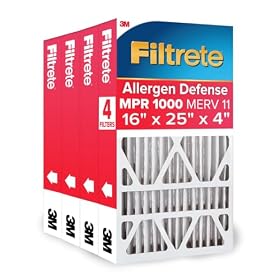 Filtrete 16x25x4 Air Filter MERV 11, MPR 1000 Micro Allergen Defense 4-Pack, Fits Lennox &…Filtrete
$79.99 as of
View on Amazon Glasfloss 20x25x4 Pleated Air Filter, 1-Pack, MERV 11, AC & FurnaceGlasfloss
$34.97 as of
View on Amazon
Product prices and availability are accurate as of the date/time indicated and are subject to change. Any price and availability information displayed on Amazon.com at the time of purchase will apply to the purchase of this product.
1-inch furnace filters
A 1-inch filter fits many standard return-air grilles and furnace filter slots. It is often the easiest size to find and usually costs less per filter. The tradeoff is limited media area, which means the filter can load with dust relatively quickly.
Advantages
- Broad availability in common nominal sizes
- Lower upfront cost
- Easy to replace in a wall, ceiling, or return-air grille
- Suitable for many systems when the selected MERV rating is appropriate
Drawbacks
- May need more frequent replacement
- A high-MERV 1-inch filter can restrict airflow more quickly as it loads
- It may be a poor substitute for a system designed around a deep media cabinet
- A visibly dirty filter can affect comfort, blower workload, and system operation
A 1-inch filter is not automatically inferior. If your equipment is designed for it and you replace it on schedule, it may be the correct choice. Do not install a thicker filter by compressing it into a 1-inch slot.
Replacement 5-inch filters
 Filtrete 16x25x5 AC Furnace Air Filter, MPR 1550, MERV 12, Fits Honeywell & Trion AirBear,…Filtrete
$30.06 as of
View on Amazon
Product prices and availability are accurate as of the date/time indicated and are subject to change. Any price and availability information displayed on Amazon.com at the time of purchase will apply to the purchase of this product.
4-inch furnace filters
A 4-inch filter generally requires a dedicated media cabinet or a compatible deep filter housing. Its greater depth allows more folded filter media than a typical 1-inch filter, which can support longer service intervals and potentially lower resistance at a comparable MERV rating.
Advantages
- More media area than most 1-inch filters
- Often better suited to higher-efficiency filtration when the HVAC system supports it
- May require less frequent replacement than a shallow filter
- Can provide a useful balance between filtration capacity and airflow
Drawbacks
- Will not fit a standard 1-inch slot
- Replacement filters can be more expensive
- The nominal size and actual size must match the cabinet
- A high-MERV option may still be too restrictive for some systems
The replacement schedule should be based on condition and manufacturer guidance, not thickness alone. Homes with pets, construction dust, wildfire smoke, or frequent heating and cooling may load a filter faster.
5-inch furnace filters
A 5-inch filter is another deep-media option. It is used with a compatible cabinet, and some systems require a specific replacement depth or filter design. It may provide substantial media area and long service intervals, but it is not a universal upgrade for a 1-inch system.
Advantages
- Large media area for systems designed to use it
- Can support effective filtration with reasonable airflow when properly selected
- May reduce how often filters need to be changed
- Useful for some larger HVAC systems or homes with higher particulate loads
Drawbacks
- Requires a deep, correctly sized cabinet
- Replacement filters may be less widely stocked
- Higher thickness does not guarantee better filtration or lower pressure drop
- Incorrect installation can allow air to bypass the filter or prevent the cabinet door from closing
Before selecting a 5-inch filter, measure the existing filter and cabinet and confirm the manufacturer’s required nominal size. Do not assume that any filter labeled 5 inches will fit.
Which thickness is best for airflow?
In general, a deeper filter has more opportunity to provide filter media area without forcing all the air through a shallow panel. That can be helpful for airflow, particularly at moderate or high MERV ratings. But the complete filter specification matters more than thickness by itself.
Airflow can be reduced by:
- A filter with a MERV rating higher than the system can handle
- A loaded or overdue filter
- A filter with a high pressure drop
- A filter installed backward or not seated correctly
- A blocked return grille or dirty evaporator coil
- Undersized or restricted return ductwork
- A blower, furnace, or air handler that is not operating correctly
If the system develops weak airflow, unusual noise, icing, overheating, or frequent limit-switch shutdowns after a filter change, turn off the equipment if necessary and consult the manufacturer or a qualified HVAC professional. Do not solve an airflow problem simply by removing the filter or choosing a lower-quality filter without identifying the cause.
Which thickness lasts the longest?
A 4-inch or 5-inch filter often lasts longer than a 1-inch filter because it can contain more media. The actual interval depends on dust load, home size, fan runtime, pets, renovations, indoor air quality, and the filter’s construction.
Check the filter monthly when you first install it. Replace it when it is visibly loaded, when the manufacturer recommends replacement, or sooner if airflow and comfort deteriorate. A calendar interval is only a starting point.
MERV rating matters separately from thickness
MERV measures a filter’s ability to capture different particle sizes under a standardized rating system. Thickness describes the filter’s physical depth. They are related to system performance but are not interchangeable.
For example, a 1-inch MERV 13 filter may create more airflow resistance than a deeper filter with a similar MERV rating, but this depends on the media design and the HVAC system. A 5-inch filter is not automatically MERV 13, and a 1-inch filter is not automatically low-efficiency.
Use the highest MERV rating that your furnace or air handler and filter cabinet can support without unacceptable pressure drop. If the equipment documentation does not specify an acceptable rating, ask an HVAC professional to evaluate the system rather than guessing.
How to choose the correct filter thickness
1. Check the existing filter
Look for the nominal size printed on the frame, such as the length, width, and thickness. Also look for the actual dimensions if they are listed. Nominal and actual dimensions are not always identical.
2. Measure the slot or cabinet
Measure the opening and available depth. The filter should slide in without force, sit squarely, and leave no obvious air gaps around the frame. Do not rely on the available space alone; the HVAC manufacturer may specify a particular replacement size.
3. Confirm the airflow direction
Most pleated filters have an airflow arrow. Install the arrow in the direction air moves—from the return duct or room toward the furnace or air handler. A filter installed backward may not perform as intended and can sometimes damage the filter media.
4. Check the system’s MERV guidance
Review the furnace, air-handler, or media-cabinet manual. If the equipment calls for a particular filter type or maximum MERV rating, follow that guidance.
5. Consider household conditions
Pets, allergies, smoke, dust, and frequent fan operation may justify a better filtration strategy, but higher filtration should not come at the expense of adequate airflow. A deeper compatible filter may be a better path than forcing a dense 1-inch filter into a system that cannot handle it.
Can you replace a 1-inch filter with a 4-inch or 5-inch filter?
Usually not without changing the filter housing. A deep filter needs a deep media cabinet or an adapter specifically designed for the HVAC system. It should not be folded, compressed, or installed with improvised spacers.
If you want to move from a 1-inch filter to a deeper option, have the cabinet and available clearance evaluated by a qualified HVAC professional. The change may also require checking the return-air path and system airflow.
When should you replace the filter or cabinet?
Replace the filter when it is dirty, damaged, wet, collapsed, or no longer seals properly. A replacement filter is the reasonable next step when the current filter is the correct size but clogged or damaged.
Consider professional evaluation or a cabinet change when:
- The existing filter loads unusually fast
- The system struggles with airflow after installing a clean filter
- You want higher filtration than the current slot can support
- The filter bows, rattles, or leaves bypass gaps
- The cabinet is damaged or cannot hold the specified filter
- You are repeatedly tempted to use a filter that does not match the slot
A cabinet upgrade is not automatically necessary. If the current system maintains airflow and the filter meets the manufacturer’s requirements, staying with the existing thickness may be the most practical choice.
FAQ
Is a 4-inch filter better than a 1-inch filter?
Not in every system. A 4-inch filter has more media area and may provide longer service life or lower resistance at a similar MERV rating, but it requires a compatible deep cabinet. The correct filter is the one that fits properly and meets the HVAC manufacturer’s airflow and filtration requirements.
Can I use a 5-inch filter in a 4-inch slot?
No. Do not compress a 5-inch filter into a 4-inch cabinet or force the cabinet door closed. Use the specified thickness and nominal dimensions, or have a qualified HVAC professional evaluate whether the cabinet can be replaced.
Do thicker furnace filters restrict airflow less?
They can, because a deeper filter may contain more media area, but thickness alone does not determine pressure drop. MERV rating, media design, filter condition, blower capacity, and ductwork also affect airflow.
How often should a 1-inch, 4-inch, or 5-inch filter be replaced?
There is no universal schedule. Check the filter regularly and follow the manufacturer’s guidance. A 4-inch or 5-inch filter may last longer than a 1-inch filter, but pets, dust, smoke, renovations, and long fan runtimes can shorten its service life.
Is a MERV 13 filter safe for every furnace?
No. Some systems can use MERV 13 filters, while others may experience excessive pressure drop, especially with a shallow 1-inch filter. Check the furnace or air-handler documentation and consult an HVAC professional if the acceptable MERV range is unclear.