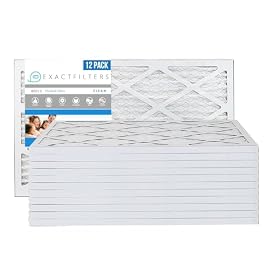
MERV 13 filters can cost more per filter than MERV 8, but the purchase price is only part of the yearly comparison. Use your filter size, replacement schedule, HVAC compatibility, and airflow needs to estimate the real annual cost.
What do you need help with?
Open an answer, or tell us what we should cover next.
Answered in this guide
Choose a furnace filter that balances clean air and airflow
Choose MERV 8 when low restriction or uncertain compatibility matters most. Choose MERV 13 when the HVAC system supports it and the added filtration is worth the higher purchase and possible operating cost.
Multiply the price of one filter by the number used each year. Calculate filters per year by dividing 12 months by the replacement interval, then compare the resulting annual cost for each MERV rating.
Compare filter purchases and possible HVAC energy costs
A complete yearly comparison includes filter purchases plus any added HVAC operating cost from airflow restriction. MERV 13 may cost more to run, but the actual difference depends on system performance and measured resistance.
MERV 13 captures smaller particles than MERV 8, and that higher filtration level often increases the purchase price. Thicker filters and designs with more filter media can add to the difference.
Requests help us prioritize the next guide. No email required.
One anonymous request per topic.
MERV 13 usually costs more per filter than MERV 8, but the yearly difference depends on more than the price printed on the package. You also need to compare how often each filter is replaced, whether your furnace is designed to handle the filter's airflow resistance, and whether a loaded filter causes the blower to work harder.
There is no universal answer such as “MERV 13 costs exactly twice as much.” Filter dimensions, brand, pack size, actual filter thickness, local prices, dust levels, pets, and HVAC design all affect the result.
The basic yearly cost calculation
Use this formula for each filter rating:
Annual filter cost = price per filter × number of filters used per year
To calculate the number of filters used:
Filters per year = 12 ÷ replacement interval in months
For example, if a filter is changed every three months, the annual usage is approximately four filters. If it is changed every two months, the annual usage is approximately six filters.
For a more complete comparison, calculate the two options separately:
This comparison should use the same size and a similar physical depth. A 16-by-25-by-1-inch filter and a 16-by-25-by-4-inch filter are not interchangeable for cost or airflow purposes, even if their nominal face dimensions are similar.
Product prices and availability are accurate as of the date/time indicated and are subject to change. Any price and availability information displayed on Amazon.com at the time of purchase will apply to the purchase of this product.
What usually makes MERV 13 more expensive
MERV 13 filters are designed to capture smaller particles than MERV 8 filters. That higher filtration level often means a higher purchase price, especially for thicker filters or filters with more media area.
The price difference is affected by:
Filter size: Larger filters contain more media and commonly cost more.
Filter depth: A deeper filter may cost more initially but can provide more media area and a longer service interval when the HVAC system supports it.
Pack size: Multipacks often reduce the per-filter price, but only compare packs with the same size and rating.
Actual construction: Two filters with the same MERV rating can have different pressure-drop and service-life characteristics.
Replacement conditions: Homes with pets, construction dust, smoking, high occupancy, or frequent fan operation may need more frequent changes.
Do not assume that changing a MERV 13 filter on the same calendar schedule as a MERV 8 filter will always produce the same airflow. The filter's condition and the HVAC system's design matter more than the rating alone.
Product prices and availability are accurate as of the date/time indicated and are subject to change. Any price and availability information displayed on Amazon.com at the time of purchase will apply to the purchase of this product.
Example: compare annual filter purchases without assuming prices
Suppose your furnace uses one filter and you replace it every three months. Your annual quantity is about four filters.
If the MERV 8 filter costs P8 and the comparable MERV 13 filter costs P13, the calculation is:
Option
Approximate filters per year
Annual filter cost
MERV 8
4
4 × P8
MERV 13
4
4 × P13
The added yearly purchase cost is:
4 × (P13 − P8)
If the MERV 13 filter loads faster and must be replaced every two months, use six filters instead:
MERV 13 annual cost = 6 × P13
This is why a lower per-filter price does not necessarily mean a lower annual cost. The replacement interval must be based on the filter's condition and the manufacturer's guidance, not just a generic “every three months” rule.
Product prices and availability are accurate as of the date/time indicated and are subject to change. Any price and availability information displayed on Amazon.com at the time of purchase will apply to the purchase of this product.
Could MERV 13 increase energy cost?
Potentially, but the answer depends on the complete HVAC system and the filter's measured resistance. A filter that restricts airflow can make the blower work harder, reduce heating or cooling performance, and contribute to comfort problems. In some systems, inadequate airflow can also cause furnace safety controls to shut the burner off or cause an air conditioner to operate improperly.
MERV rating alone does not tell you exactly how restrictive a filter will be. Look for the manufacturer's pressure-drop information when it is available, and check the furnace or air-handler documentation for the approved filter type and maximum resistance.
A MERV 13 filter may be a reasonable choice when:
The furnace or air handler manufacturer allows it.
The filter rack is designed for that filter type and depth.
The system can maintain the required airflow.
The filter is checked regularly and replaced before it becomes heavily loaded.
A qualified HVAC professional confirms compatibility when the documentation is unclear.
A MERV 8 filter may be the safer choice when the equipment documentation does not support a higher rating, the system already has weak airflow, or the filter slot is a restrictive one-inch design. Do not force a thicker filter into a shallow rack or use a filter that does not fit securely.
How to include energy in the comparison
The simplest comparison is the annual filter purchase cost. A more complete calculation adds the estimated HVAC operating-cost difference:
The second number is difficult to estimate reliably without system measurements. It can vary with:
Blower motor type and control strategy
Heating and cooling runtime
Fan speed and duct design
Filter size and depth
Filter loading over time
Electricity or fuel rates
Indoor and outdoor conditions
Avoid assigning a fixed energy penalty to all MERV 13 filters. Two filters with the same MERV rating can have different pressure-drop characteristics, and a clean filter will not behave like a loaded filter.
If you notice weak airflow, longer heating or cooling cycles, unusual furnace cycling, whistling at the filter, or rooms that no longer reach the set temperature, check the filter and system setup. If the problem continues with a clean, correctly installed filter, have the HVAC system evaluated rather than simply switching ratings repeatedly.
A practical way to choose between MERV 8 and MERV 13
Choose MERV 8 when compatibility and low restriction are the priority
MERV 8 is often the more conservative purchase for a system with a shallow filter slot or uncertain airflow capacity. It may also be appropriate when the equipment documentation specifies a lower rating. The filter still needs to be replaced when dirty; a neglected MERV 8 filter can restrict airflow too.
Choose MERV 13 when the system supports it
MERV 13 can make sense when improved fine-particle filtration is important and the HVAC manufacturer permits it. Before buying a recurring supply, confirm the exact size, filter depth, installation direction, and any available pressure-drop guidance.
If indoor air quality is the main reason for upgrading, also consider whether the filter rack can accept a deeper filter. A properly fitted deeper filter may offer more media area than a very restrictive high-MERV filter in a shallow slot, but the correct choice depends on the equipment and rack design.
How to get a reliable yearly estimate
Record the exact filter dimensions. Use the size printed on the existing filter or measure the opening carefully. Nominal and actual dimensions can differ.
Confirm the filter depth. A one-inch filter is not automatically interchangeable with a two-, three-, or four-inch filter.
Check your equipment documentation. Look for an approved MERV range, pressure-drop limit, or filter replacement guidance.
Record the current replacement interval. Note how quickly the filter becomes visibly loaded rather than relying only on a calendar reminder.
Compare per-filter prices for equal quantities. Convert multipacks to a per-filter figure.
Calculate annual purchase cost for both ratings. Use realistic replacement intervals for your home.
Watch airflow after changing ratings. Check for new whistling, reduced supply airflow, longer cycles, or unusual temperature differences.
Recheck the filter during the first few weeks. A filter that appears acceptable at installation may load quickly during renovation, wildfire smoke, pollen season, or heavy occupancy.
When the higher annual cost is worth it
The extra cost of MERV 13 may be reasonable when the system is compatible and the household places a high value on capturing smaller airborne particles. It is less compelling when the upgrade causes airflow problems, does not fit correctly, or is used in equipment that was not designed for its resistance.
In many homes, the best value is not the highest available MERV rating. It is the highest rating the HVAC system can support while maintaining proper airflow, combined with regular replacement and a well-sealed filter rack.
Bottom line
Compare MERV 13 and MERV 8 using annual filter purchases first, then consider airflow and HVAC operating effects. MERV 13 will often have the higher yearly purchase cost, but the difference cannot be calculated accurately without your filter size, price, replacement interval, and system requirements.
Before upgrading, verify compatibility in the furnace or air-handler documentation. If airflow is already poor or the required rating is unclear, ask a qualified HVAC professional to check the system rather than assuming a higher MERV rating is automatically better.
FAQ
Is MERV 13 always more expensive than MERV 8 over a year?
Usually, MERV 13 has a higher per-filter purchase price, but the yearly difference depends on filter size, pack pricing, replacement frequency, and how quickly each filter loads in your home. Calculate the annual quantity instead of comparing only one filter.
Can I use a MERV 13 filter in any furnace?
No. Check the furnace or air-handler documentation for the approved filter rating, size, depth, and airflow requirements. A higher-MERV filter can be unsuitable if the system or shallow filter rack cannot handle its resistance.
Does MERV 13 make the furnace work harder?
It can if the filter creates more airflow resistance than the system is designed to handle, especially as the filter becomes dirty. MERV rating alone does not provide enough information to predict the effect; pressure-drop data and system requirements are more useful.
How often should I replace a MERV 8 or MERV 13 filter?
Use the equipment and filter manufacturer's guidance as a starting point, then inspect the filter under your home's actual conditions. Pets, dust, smoke, renovations, and frequent fan operation can require more frequent replacement.
Is a deeper MERV 13 filter better than a one-inch MERV 13 filter?
Not automatically, but a deeper filter may provide more media area and potentially lower resistance when the HVAC system and filter rack are designed for it. Never install a deeper filter unless it fits correctly and is approved for the equipment.